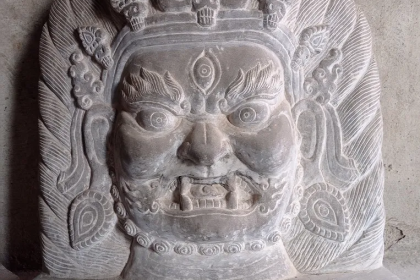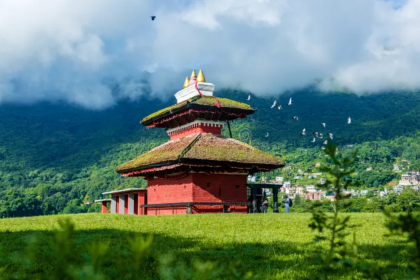

Lalitpur, also known as Patan, is one of the three historic cities of the Kathmandu Valley. It lies just south of Kathmandu and is famous for its rich Newari culture, fine arts, and traditional architecture. The city especially features Patan Durbar Square, a UNESCO World Heritage Site filled with temples, courtyards, and palaces.Lalitpur has long been a center of metalwork, wood carving, and stone sculpture, making it the artistic heart of the valley.
Overview
Artisans in Lalitpur create its identity as the “City of Fine Arts” through their skilled work in metal statues, wood carvings, and traditional handicrafts.. The city also hosts many festivals such as Rato Machhindranath Jatra, one of the longest chariot festivals in Nepal, showing the strong link between religion and community life. Beyond monuments, traditional settlements like Khokana and Bungamati preserve ancient lifestyles and customs within Lalitpur.

Since this place is rich in culture and arts, recommended must visit places are:
Patan Durbar Square
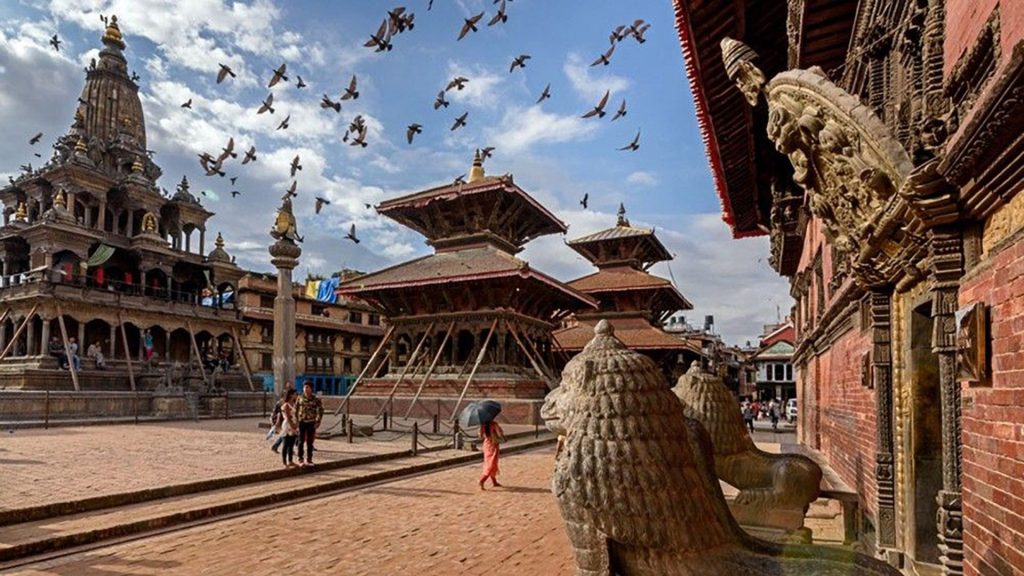
Patan Durbar Square is a historic royal palace complex located in the heart of Lalitpur (Patan), NepalOnce the Malla kings ruled from it, and today it stands out for its exquisite Newar architecture and dense concentration of temples, courtyards, and shrines.
The site is part of the Kathmandu Valley UNESCO World Heritage property and remains a living center of art, culture, and devotion.

Historical Background
The square developed as the royal palace complex of the Malla kings who ruled Patan between the 14th and 18th centuries. Their patronage fostered a golden age of art and architecture, with stone, bronze, and wood carvings that display exceptional craftsmanship. The area’s courtyards Mul Chowk, Sundari Chowk, and Keshav Narayan Chowk formed the nucleus of palace life and administration.

Krishna Mandir
Krishna Mandir is a 17th-century stone temple located at Patan Durbar Square in Lalitpur, Nepal. Dedicated to Lord Krishna, it is a premier example of Shikhara-style architecture and a central feature of this UNESCO World Heritage site. The temple embodies both the spiritual devotion and artistic mastery of the Malla period.

Historical Background
Commissioned after the Malla king dreamed of Krishna and Radha standing before his palace, the temple became the earliest stone-built Hindu shrine of its kind in Nepal. It signified a departure from the valley’s traditional brick-and-timber construction, establishing a new model of craftsmanship for Newar artisans.
Patan Museum
Patan Museum is a prominent cultural and historical museum located within the ancient palace complex of Patan Durbar Square in Lalitpur, Nepal. It showcases Nepal’s rich artistic and religious heritage, particularly the Hindu and Buddhist traditions that shaped the Kathmandu Valley’s civilization.

Historical Background
The museum occupies a section of the former royal palace of the Malla kings, rulers of Patan during the medieval period. Following decades of decline, it underwent a major restoration in collaboration with the Austrian government and reopened in 1997. People widely regard the project as a model for heritage conservation in South Asia, as it blends traditional Nepali craftsmanship with modern museology.
Hiranya Varna Mahavihar (Golden Temple)
Hiranya Varna Mahavihar, also known as the Golden Temple or Kwa Baha, is a historic Newar Buddhist monastery in Patan (Lalitpur), Nepal. Dating to the 11th–12th century CE, it exemplifies the fusion of religion and art that defines the Kathmandu Valley’s heritage. Its gilded façade and living monastic traditions make it one of Nepal’s most venerated landmarks.

Historical Background
Believed founded under King Bhaskar Varman, the monastery has long served as a center of Newar Buddhism. Legends tell of a “golden mouse and cat” omen prompting its construction. It houses the sacred 800-year-old text Pragya Paramita, recited publicly during major festivals.Authorities repaired the complex after the 2015 Gorkha earthquake, following Nepal’s heritage-preservation laws.
Mahabouddha Temple
Mahabouddha Temple, also known as the “Temple of a Thousand Buddhas,” is a 16th-century Buddhist monument in Patan (Lalitpur), Nepal. People celebrate it for its intricate terracotta craftsmanship and thousands of Buddha images carved on its brick façade. Inspired by the Mahabodhi Temple in India, it exemplifies the fusion of Nepali and Indian architecture within the Kathmandu Valley’s Buddhist heritage.

Historical Background
The temple was commissioned by Abhaya Raj Shakya, a priest from the local Shakya community, after returning from a pilgrimage to India. With royal patronage, construction spanned three generations over 36 years. Each terracotta tile bears a small image of the Buddha, giving the temple its “thousand Buddhas” epithet.
Severely damaged in the 1934 earthquake, the temple was later rebuilt using surviving bricks, though its original appearance changed. Despite being tucked within a residential quarter, Mahabouddha remains a cornerstone of Patan’s artistic identity and an emblem of Newar ceramic mastery.
Design and symbolism
Mahabouddha departs from the typical multi-tiered pagoda style of Nepalese temples, adopting instead the Indian shikhara tower form. The temple’s façade glows warmly in sunlight, and the interior enshrines a two-meter-tall statue of Shakyamuni Buddha. A brass demon-suppressing pestle placed before the temple is said to emit a shine from centuries of devotees’ touch.
Kumbeshwar Temple
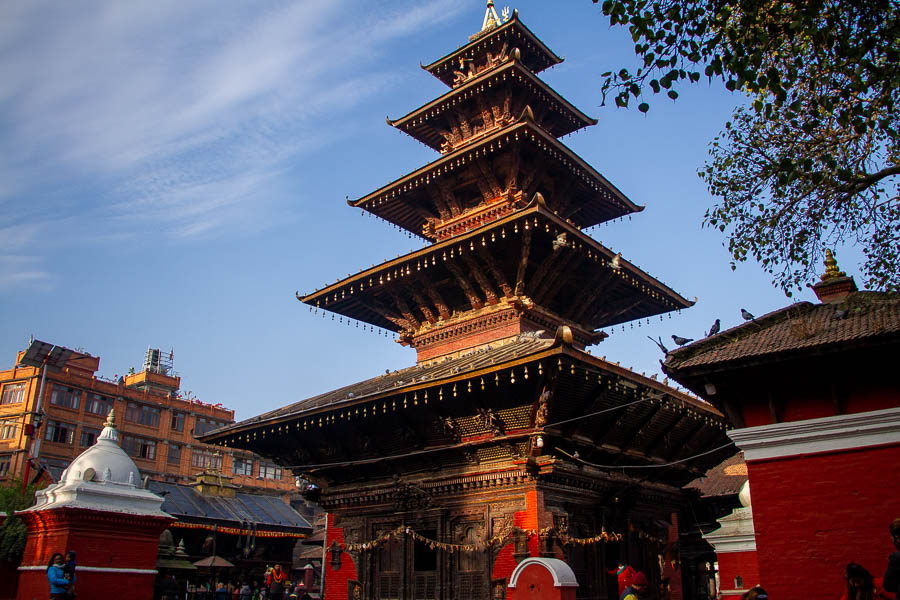
Kumbeshwar Temple is a five-tiered pagoda-style Hindu temple located in Patan, Lalitpur, Nepal. Dedicated to Lord Shiva, it is one of the city’s oldest and most significant religious monuments, notable for its elegant Newar architecture and its importance in annual rituals and festivals.
Key facts
- Deity: Lord Shiva
- Built: 14th century (reign of King Jayasthiti Malla)
- Location: Patan, Lalitpur District, Nepal
- Architectural style: Newar pagoda
- Notable festival: Janai Purnima (Sacred Thread Festival)
Historical background
Constructed during the Malla period, Kumbeshwar Temple is one of only a few five-tiered temples in the Kathmandu Valley. Tradition attributes its foundation to King Jayasthiti Malla, reflecting the Malla rulers’ patronage of art, religion, and urban design. The temple’s age and craftsmanship make it a central example of medieval Newar sacred architecture.
Bungamati
Bungamati is an ancient Newar village in the Lalitpur District of Nepal, located about nine kilometers south of Kathmandu. People know it as the home of Rato Machhindranath (also called Bunga-dyo or Karunamaya), one of the most revered deities of the Kathmandu Valley, and they regard it as a living repository of traditional Newar culture, art, and architecture.

Key facts
- Location: Karyabinayak Municipality, Lalitpur District, Nepal
- Elevation: Approx. 1,400 m above sea level
- Founded: Likely before the 7th century CE (Licchavi period)
- Main deity: Rato Machhindranath (Bunga-dyo)
- Cultural focus: Woodcarving, festivals, Newar architecture
Historical background
Epigraphic evidence suggests Bungamati—then known as Bugayumi—existed as early as 605 CE under Licchavi King Amshuverma. During the Malla era, it flourished as Bungapattan, a planned town with temples and courtyards. The settlement later became a vital religious and artistic hub for the Newar community, whose artisans’ woodcarving traditions continue today.
Religious and cultural significance
At the heart of Bungamati, the Rato Machhindranath Temple stands as a Shikhara-style sanctuary, where the rain-god Machhindranath resides for six months each year before devotees carry him to Patan during the famed Bunga Dyah Jatra chariot festival.
Nearby stands the Karya Binayak Temple, dedicated to Lord Ganesha, a major pilgrimage site overlooking the Bagmati Valley. The village also maintains a local Kumari (living goddess), a tradition shared only by a few Newar towns.
Khokana
Khokana is a traditional Newar village in the southern part of Lalitpur District, Nepal, about 8 km south of Kathmandu. The village features a medieval urban layout and a mustard-oil heritage, and authorities have proposed it for inscription on the UNESCO World Heritage List. It remains a living example of Nepal’s vernacular architecture and communal culture.

Key facts
- Location: Lalitpur District, Bagmati Province, Nepal
- Altitude: 1,320–1,358 m above sea level
- Founded: Malla period (15th century)
- Heritage status: On UNESCO Tentative List since 1996
- Known for: Traditional mustard-oil industry, Newar festivals, and architecture
Historical background
Khokana emerged as a planned medieval settlement during the Malla dynasty.King Amar Malla established its central shrine, the three-tiered Rudrayani Temple, around 1513 CE. The village was the first in Nepal to receive electricity, in 1911, through the Pharping Hydropower project—well before nearby Kathmandu.
Cultural and architectural heritage
Stone-paved alleys, courtyards (chowks), and brick-and-timber Newari houses define Khokana’s landscape. The layout incorporates ponds such as De Pukhu (“God Pond”) used for rituals. Temples and chaityas dot the settlement, reflecting both Hindu and Buddhist influences. Distinctively, residents traditionally abstain from rearing chickens and using garlic, customs linked to local religious beliefs.
Patan Dhoka
Patan Dhoka is the historic northern gateway to the old city of Lalitpur (also called Patan) in Nepal’s Bagmati Province. It serves as both a symbolic and physical entrance to one of the Kathmandu Valley’s most important centers of Newar art, culture, and craftsmanship.

Key facts
- Location: Yala Dhwakha Marg, Lalitpur, Bagmati Province, Nepal
- Coordinates: 27.679° N, 85.321° E
- Elevation: 1,316 m (4,318 ft)
- Built: Likely during the Malla period (13th–18th centuries)
- Nearby landmark: Patan Durbar Square (UNESCO World Heritage Site)
Historical background
Constructed during the Malla era, Patan Dhoka once functioned as the main city gate among several gates that surrounded ancient Patan. However, the 1934 earthquake heavily damaged the structure. Since then, authorities have restored it multiple times, with the most recent restoration completed in 2018. Throughout each reconstruction, craftsmen have carefully preserved its traditional Newar style, using intricately carved wood and brick architecture that reflects the valley’s royal heritage.
Sundari Chowk
Sundari Chowk is a historic courtyard within Patan Durbar Square, Nepal, renowned for its exquisite Newar palace architecture and detailed wood-and-stone craftsmanship. It once formed part of the royal Malla palace complex, and it now serves as a central feature of the Patan Museum, where people celebrate it as a masterpiece of 17th-century Kathmandu Valley artistry.

Historical background
Sundari Chowk was built in the early 1600s as an inner royal courtyard adjoining the Malla kings’ palace in Patan. Named “Sundari,” meaning “beautiful,” it reflects the refinement of Malla-period palace culture, where architecture, religion, and royal rituals closely connect. In addition, the courtyard served both as a ceremonial space and as private royal quarters.
Mul Chowk
Mul Chowk forms the central and largest courtyard within the royal palace complex of Patan Durbar Square in Lalitpur, Nepal. It showcases Newar palace architecture and holds strong religious and historical importance as part of the former Malla royal residence. Moreover, it continues to stand as a key feature of the UNESCO World Heritage–listed Kathmandu Valley monuments.

Historical significance
Mul Chowk, meaning “main courtyard,” was built during the Malla dynasty, a period marked by artistic and architectural advancement in the Kathmandu Valley. Moreover, it served as the principal ceremonial space of the Patan royal palace, where kings conducted religious rituals and state ceremonies, especially those dedicated to Taleju, the royal goddess of the Malla rulers.
Nature & Relaxation Spots:
Godavari Botanical Garden
The Godavari Botanical Garden is a major botanical and recreational site located at the foothills of Phulchoki Mountain in Lalitpur District, Nepal. Established in 1962, it serves both as a conservation center for native Himalayan flora and a popular getaway near Kathmandu for nature study and leisure.
History and purpose
The garden was founded during the reign of King Mahendra with technical assistance from the United Kingdom. Moreover, it was designed both as a research station for botanical studies and as a public garden. Over time, it developed into an important part of Nepal’s efforts to document and conserve its rich plant biodiversity.


Collections and its Biodiversity
The garden maintains thousands of species of native and exotic plants, organized into thematic sections such as tropical houses, rock gardens, arboretum, and fern houses. It features many Himalayan species including orchids, rhododendrons, and medicinal plants. Seasonal flowering displays and tree canopies offer year-round visual interest.
Central Zoo
Central Zoo lies in Jawalakhel, Lalitpur, and serves as Nepal’s only national zoological park, acting as a key center for wildlife conservation, education, and recreation. Moreover, the National Trust for Nature Conservation (NTNC) has managed it since 1995. In addition, the zoo houses a wide range of native and exotic species, while also functioning as an important hub for environmental awareness and animal welfare.
Animals and Exhibits
Spanning six hectares, Central Zoo shelters around 120 species of mammals, birds, reptiles, and fish. Notable residents include the Bengal tiger, one-horned rhinoceros, Asian elephant, red panda, Himalayan black bear, and various primates and reptiles. Specialized exhibits like the aviary, aquarium, and primate enclosures promote understanding of Nepal’s biodiversity.
History and Management
Initially a private menagerie founded in 1932, the zoo opened to the public in 1956 following Nepal’s political reforms. The Government of Nepal transferred its management to NTNC in 1995 under a long-term agreement, marking a modern era of conservation and education-focused management. NTNC continues to upgrade animal habitats, veterinary services, and visitor facilities.

Religious & Cultural Sites:
Rato Machhindranath Temple
The Rato Machhindranath Temple in Bungamati, Lalitpur, Nepal, is a revered shrine dedicated to the rain god and patron deity of the Kathmandu Valley’s farmers. It holds immense religious, cultural, and historical significance for both Hindu and Buddhist communities in the region.
Historical background
According to legend, the god Machhindranath was brought to the Kathmandu Valley to end a severe drought, symbolizing compassion and the life-giving power of rain. The temple, built in the Licchavi period, has long been central to agrarian and spiritual life. Bungamati is believed to be the deity’s permanent home, where the idol resides for much of the year.


Cultural significance
Rato Machhindranath is regarded as the god of rain and fertility, worshiped by Hindus as an incarnation of the bodhisattva Avalokiteshvara. Every year, his image is placed on a tall wooden chariot and paraded through Patan during the grand Rato Machhindranath Jatra one of the longest and most colorful festivals in Nepal before being returned to Bungamati.
Ashoka Stupas
The Ashoka Stupas of Patan (Lalitpur), Nepal, are a group of four ancient Buddhist monuments traditionally attributed to Emperor Ashoka during his 3rd-century BCE pilgrimage to the Kathmandu Valley. Each stupa marks one of the four cardinal directions around Patan, symbolizing the spread of Buddhism and defining the city’s sacred geography.


Historical background
According to local chronicles, Emperor Ashoka visited Patan with his daughter Charumati during his mission to propagate Buddhism. He is believed to have commissioned the four stupas to sanctify the city and establish it as a spiritual center. Though archaeological evidence suggests later restorations, their design and symbolic placement align with early Buddhist architectural traditions.
Banglamukhi Temple
Banglamukhi Temple is a historic Hindu shrine in Patan, Lalitpur, Nepal, devoted to Goddess Banglamukhi, a fierce manifestation of Goddess Durga. Renowned for its spiritual energy and vibrant rituals, the temple is a key center of Tantric worship in the Kathmandu Valley and draws both devotees and cultural visitors year-round.


History and significance
According to local legend, a Malla-era queen established the temple in the 17th century seeking divine aid in battle. The goddess Banglamukhi symbolizes power over negativity and obstacles, and her blessings are believed to silence harmful speech and defeat enemies. Over time, the site became one of Patan’s most revered Shakti Peeths, forming a spiritual counterpart to other Durga shrines in Nepal.
Uku Bahal
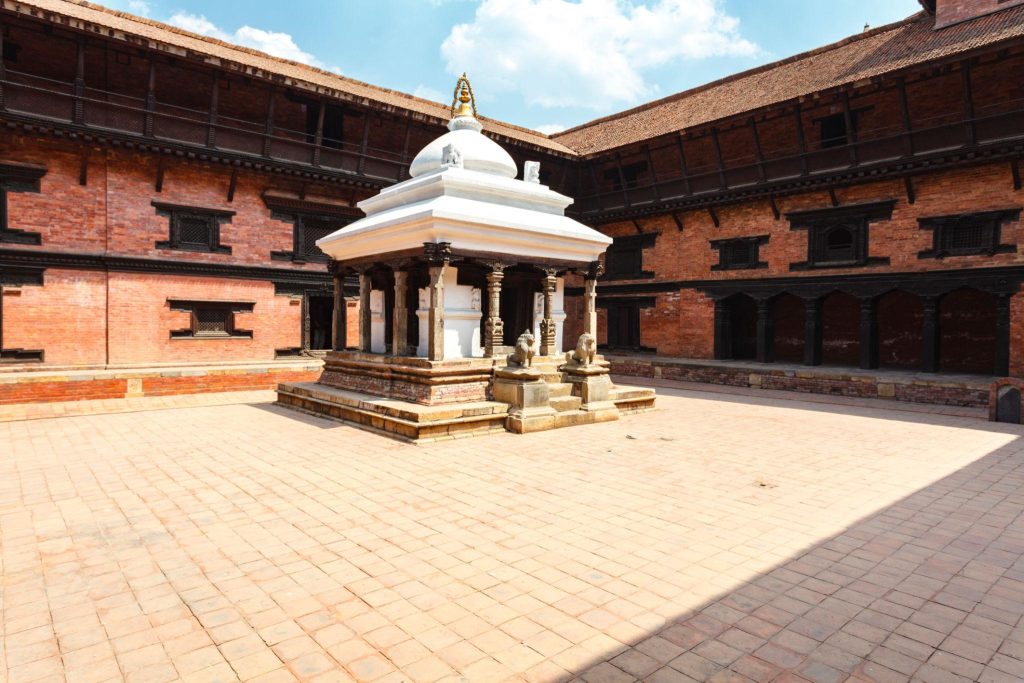
Uku Bahal, also known as Rudra Varna Mahavihar, is a historic Buddhist monastery (bahal) in Patan, Lalitpur, Nepal. It is one of the most revered and artistically rich monastic courtyards in the Kathmandu Valley, renowned for its ornate bronze sculptures, ritual significance, and Newar Buddhist heritage.

Key facts
- Location: Patan (Lalitpur), Nepal
- Religious affiliation: Newar Buddhism
- Also known as: Rudra Varna Mahavihar
- Estimated origin: 12th century CE
- Function: Active monastery and museum of sacred art
Historical background
Uku Bahal traces its origins to the medieval Malla period, when Patan flourished as a center of Buddhist learning and craftsmanship. It has long served as a monastic complex for Newar monks and devotees of Vajrayana Buddhism. The site has been patronized by kings and artisans alike, and legends link it to the coronation rituals of Malla monarchs.
Art, Culture & Local Life:
Yala Mandala Art Gallery
Yala Mandala Art Gallery is a contemporary cultural and artistic space located in Patan, Lalitpur, Nepal. It serves as both an exhibition venue and a community hub promoting Nepali fine arts, traditional crafts, and sustainable design. The gallery is known for merging heritage architecture with modern art presentation, drawing both local and international visitors.


Community Engagement
Yala Mandala functions as a cultural meeting point that fosters collaboration among artists, artisans, and entrepreneurs. Its mission emphasizes the preservation of Newar heritage and the promotion of sustainable creative industries, contributing to Patan’s identity as a center for art and culture in the Kathmandu Valley.
Patan Handicraft Streets
Patan is famous as Nepal’s center of traditional handicrafts, where skills have been passed down for generations. The local handicraft areas are not just markets—they are working zones where you can see artisans creating items by hand.


| M | T | W | T | F | S | S |
|---|---|---|---|---|---|---|
| 1 | 2 | 3 | 4 | |||
| 5 | 6 | 7 | 8 | 9 | 10 | 11 |
| 12 | 13 | 14 | 15 | 16 | 17 | 18 |
| 19 | 20 | 21 | 22 | 23 | 24 | 25 |
| 26 | 27 | 28 | 29 | 30 | 31 | |