Introduction
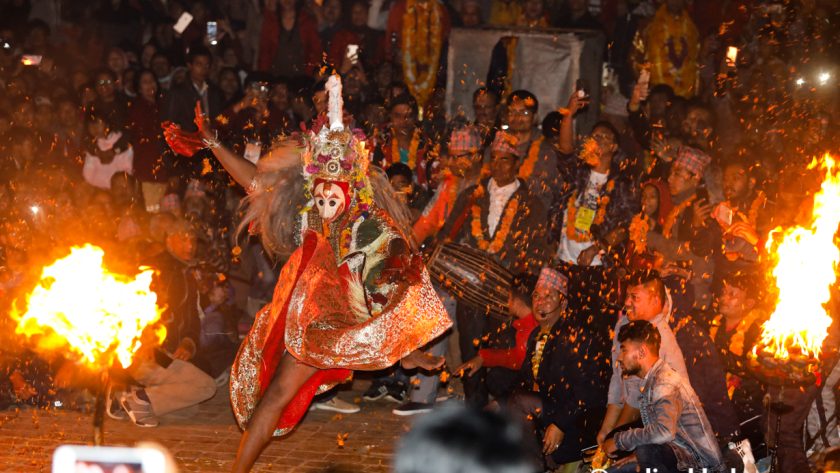
In the heart of Patan’s ancient Durbar Square, as torches are lit in the four corners of the Kartik Dabali and the night air fills with the sound of traditional instruments, a centuries old miracle of culture and devotion comes alive. Kartik Naach, also known as Katti Pyakhan, is a vibrant celebration of art, devotion, and heritage one of South Asia’s oldest living performance traditions. For over three and a half centuries, this remarkable dance drama has been staged without interruption, carrying within it the mythology, spirituality, and artistic soul of the Newar people.
Historical Origins
Kartik Naach is a Newar musical theatre performed in the month of Kartik (October or November) in Nepal. It was started in 1641 AD by King Siddhi Narsingh Malla. The circumstances of its founding are as fascinating as the festival itself.
Kartik Naach started when Siddhinarsingh Malla’s gurus told him that there was a dosh (bad omen) surrounding the state, and told him they had to perform a narabali a human sacrifice for Patan to prosper. The king could not sacrifice anybody, as he knew it would be objected to by the general public. As the king was a faithful devotee of Lord Vishnu, they planned to organise a play in which the Narsingha avatar defeats the evil Hiranyakashipu, and since then this dance has been going on.
Kartik Naach was also first started to celebrate the completion of the Krishna Mandir, the temple dedicated to Lord Krishna, situated inside the Durbar Square. He began the dance-drama as a protective measure for his kingdom and to get rid of the general despair his kingdom had fallen into.
Historical records show that the dance began in Nepal Sambat 761 (1697 AD). The dance was initially performed for five days. Srinivas Malla, son of Siddhi Narasingh Malla, extended it to 15 days by adding the Bathah Pyakhan (folk drama), Sudama Pyakhan, and Surdas Pyakhan.
The Venue: Patan Durbar Square
Held at the UNESCO World Heritage Site of Patan Durbar Square, the festival has retained its authenticity through centuries of political changes, cultural shifts, and even natural calamities. The performances take place on the Kartik Dabali a raised stone platform in front of the Krishna Mandir which transforms each evening into one of the world’s most atmospheric open-air stages. As a pleasant night falls over the dabali, men light torches in the four corners to demarcate the stage. As the crowd pours in, the musicians tune their instruments and the actors adjust their costumes for a final time before staging the annual celebration.
Narrative and Themes: Seventeen Tales of Vishnu
This 383-year-old Kartik Naach is believed to be associated with 17 stories of Lord Vishnu. Every day, different episodes of Lord Vishnu’s stories are performed, making the dance unique among Nepal’s cultural heritage.
The dance celebration sees reenactments of the Vishnu Purana Vishnu’s many adventures in his various avatars and was originally conceptualised as a five day event to bring together all the people in the Malla Kingdom of Yala (Patan) to provide them with religious, ethical, and social teachings.
The daily programme progresses through a carefully sequenced mythological arc. On the fifth day, the Devi Pyakhan includes the dances of Bhairav, Balkumari, and Mahalaxmi. On the sixth day, the performers depict the ocean as Lord Vishnu’s bed in the Jalasayan, followed by the war of Mahamaya against Madhu and Kaitab. On the seventh day, the performers stage the battle between the Varaha (boar) avatar and the demon Hiranyaksha, showcasing his defeat. After that, on the eighth day, the performers stage the battle between the Narasimha avatar and Hiranyakashyapu, depicting the demon king’s defeat.
On the last day of the festival, the dance of Narsimha Avatar is presented said to be the highlight of the festival, with all the lights, music, and action. The dance depicts the story of how Lord Vishnu incarnated as a half-lion, half-human called Narsimha and killed Hiranya Kasipu immediately after the sunset for protecting his son Prahlad, a devotee of Lord Vishnu. Hiranya Kasipu had the boon that none of the humans, animals, or birds could kill him at any time of day or night.
Performance Structure and Language
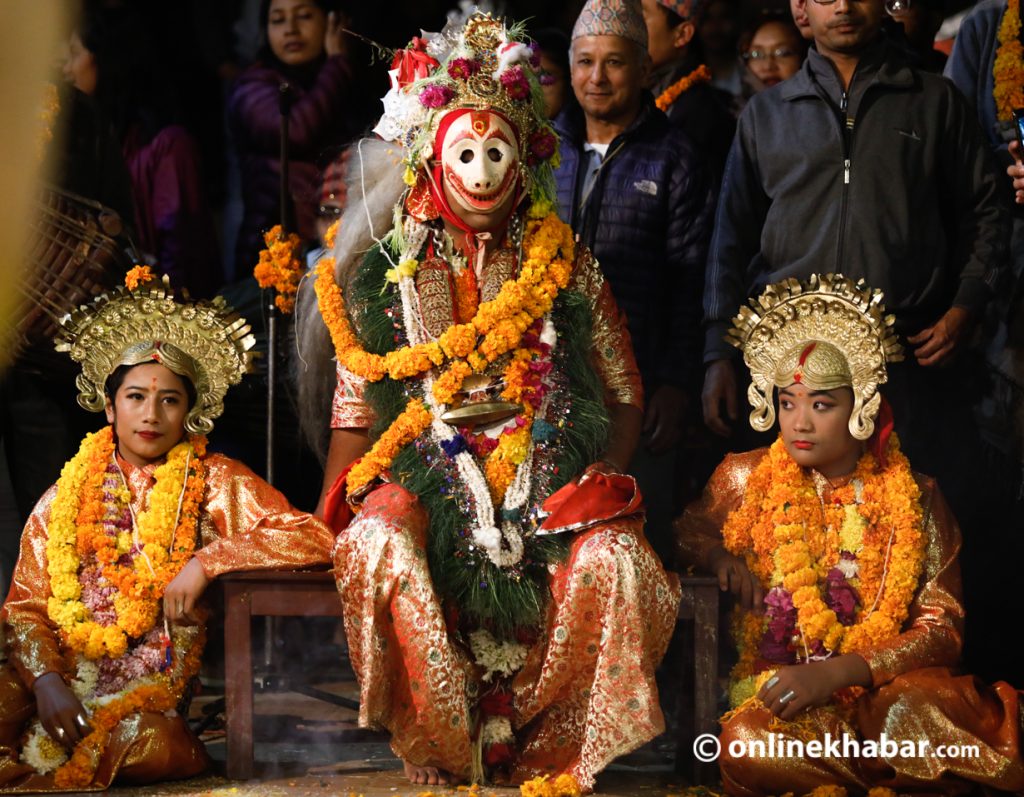
The play usually starts with dancers in colourful clothes portraying Hindu deities including Shiva, Ganesh, Barahi, and Krishna. The dance requires 20 artists for a single day’s performance.
The performances combine elements of classical dance, music, and ancient Sanskrit based drama, making it one of the most elaborate cultural events in Nepal.
An interesting linguistic evolution has shaped the festival over the centuries. During the Malla period, Maithili language was in use in the dance. Now, it has been changed to Nepal Bhasa to make it more accessible to the Newa community.
Gender and Tradition
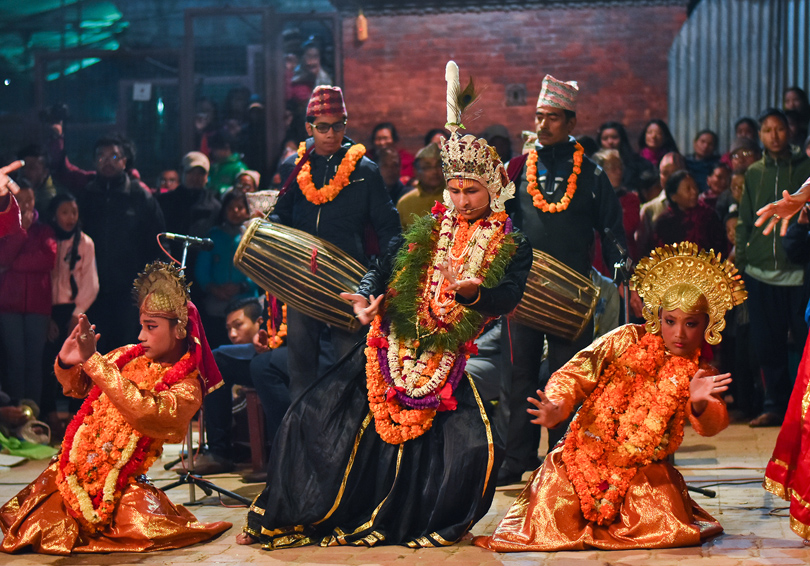
One of the most intriguing aspects of Kartik Naach is its all-male cast. From the very beginning, all roles including female characters were performed by men. This was due to social restrictions on women at the time. Kartik Naach is a tantric dance, and traditional beliefs surrounding menstruation contributed to women’s exclusion. In recent years, this convention has become a subject of cultural debate, as communities reflect on the balance between preserving tradition and embracing inclusion.
The Duration: From 27 Days to the Present
The festival, regarded as the world’s longest theatrical event, historically spanned 27 days. However, following the 1951 revolution, it was shortened. Between 1952 and 1980, it was condensed to two days. From 1981 to 2012, the dance lasted eight days, later extending to 10 days in 2013 and 12 days until 2019. Due to the COVID-19 pandemic, only two performances were held in 2020. Since then, the full 27 day festival has not been revived due to the time and resources required.
Challenges and Preservation
Despite its cultural magnificence, Kartik Naach faces serious threats to its survival. Organisers face financial challenges in conducting the festival. It requires at least 20 performers each day, and it is difficult to pay them adequately. Younger artists also face language barriers, with many migrating abroad.
The Kartik Dance Preservation Committee has established a goal to set up a fund of 100 million rupees to sustain the festival. The committee also plans to provide scholarships and health insurance for artists, as well as language training for the next generation. Lalitpur Metropolitan City has already contributed 10 million rupees to the endowment fund.
Cultural Significance
The commitment of local artists and the community in preserving this legacy underscores the deep cultural continuity in Nepalese society. Kartik Naach is a living museum that preserves the Valley’s heritage. As the dev ganas perform divine scenes of creation, cosmic battles, and the victory of good over evil, the audience cheers with devotion, awaiting the climax where the Narsingha Avatar slays Hiranyakashipu a symbolic reminder that evil, once again, has been defeated for the year.
Conclusion
Kartik Naach or Gan Pyakhan is far more than a festival. It is Patan’s spiritual heartbeat, a living bridge between the 17th century and the present day, between mythology and human devotion. In an age of rapid modernisation, the sight of torch lit dancers in elaborate costumes retelling the eternal stories of Vishnu on an ancient stone platform speaks powerfully of a community’s will to remember who it is and where it comes from. To witness Kartik Naach is not merely to attend a performance it is to step inside a civilisation still very much alive.