Introduction
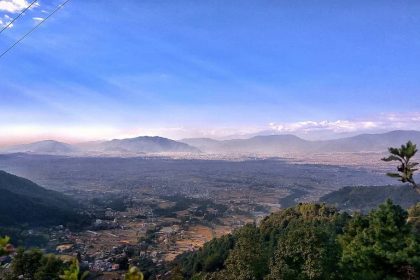
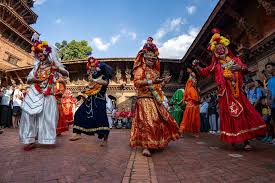
Nestled in the heart of the Kathmandu Valley, Lalitpur also known as Patan or Yala has long been celebrated as the “City of Fine Arts.” Among its many living cultural treasures, few are as spiritually profound or historically rich as the Astamatrika Naach, locally known as Gaan Pyakhan (literally “Group Dance” in the Newar language). This centuries-old masked dance tradition is a testament to Lalitpur’s unique synthesis of Hindu and Buddhist heritage, a living ritual that has endured for over 350 years and continues to enchant performers, devotees, and visitors alike every year during the festival of Dashain.
What is Astamatrika Naach?
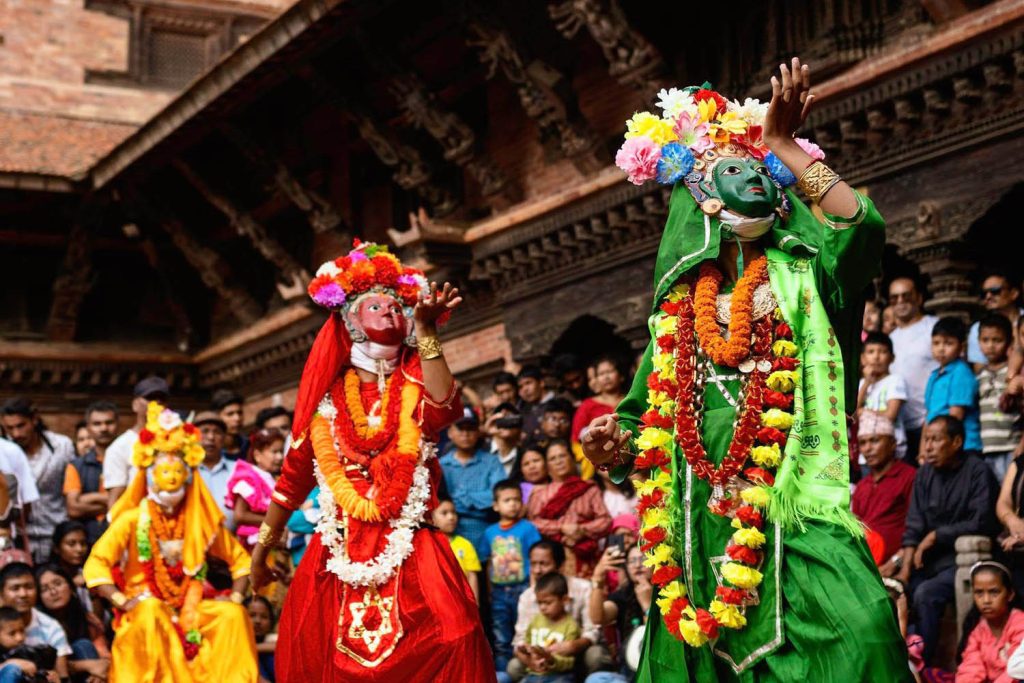
The word Astamatrika comes from Sanskrit: Asta meaning eight, and Matrika meaning mother goddess. The dance honours the eight principal mother goddesses of the Newar pantheon Brahmayani, Mahesvari, Bal Kumari (Kaumari), Vaishnavi, Varahi, Indrayani, Mahakali (Chamunda), and Mahalaxmi alongside a broader cast of thirteen deities that includes Bhairav, Kumar, Ganesh, Simhini, and Vyaghrini.
The dance is also called Gaan Pyakhan in the Newar language, where Gaan means group and Pyakhan means dance. It is a sacred, ceremonial performance deeply embedded in the religious and social life of Patan, particularly among the Shakya and Bajracharya clans of the Newar community.
Historical Origins: A Dream and a Royal Decree
The origins of Astamatrika Naach are rooted in both history and mythology, inseparable in the Newar cultural tradition. The dance was introduced during the reign of King Sri Nivas Malla (1627–1687 AD), a devout ruler regarded by his people as an emanation of Bodhisattva Avalokiteshvara.
According to well documented legend, on a quiet night in the seventeenth century, King Sri Nivas Malla was unable to sleep. As he sat by the window of his palace gazing out over what is today Patan Durbar Square, he heard the soft tinkling of anklets. Looking into the moonlit courtyard of Mulchowk, he beheld a breathtaking vision eight radiant figures dancing their way into the royal court. As he rushed to witness the sight more closely, the eight mother goddesses had already ascended. The king awoke convinced he had received a divine blessing.
To interpret the significance of his vision, the king consulted a Brahmin priest, Madhusudan of Gabahal Tole, and Sri Kulapad Acharya of Nyakhachowk near Patan Gate. They advised him that the dream was an auspicious sign a blessing of the mother goddesses upon his kingdom and recommended that the dance be re-enacted annually to honor the deities. The king, himself a scholar and a tantric practitioner, composed charyagita (sacred songs) for the deities, while Bajracharya Kulapada arranged the full ceremonial and choreographic procedures in the Buddhist Tantric tradition.
To ensure the dance would be sustained in perpetuity, the king donated land assets (guthi) to three community organizations the guthis of Nakabahil, Bubahal, and Okubahal entrusting them with the responsibility of organizing the performance every year.
The Performance: Venues, Timing, and Structure
The Astamatrika Naach commences on Ghatasthapana, the first day of the Dashain festival according to the Hindu lunar calendar (typically in September or October), and continues for eleven days, concluding on the night of Ekadashi. The festival period corresponds to one of the most sacred times in the Newar calendar, making the dance both a religious act of worship and a communal celebration.
The dance is staged at three sacred locations in Lalitpur:
- Mulchowk, the royal inner courtyard of Patan Durbar Square, where legend says the goddesses first appeared to King Sri Nivas Malla
- Kartik Dabali, an open performance space near the durbar square
- Nakabahil Dabali, the courtyard of the Nakabahil community
Each venue holds a different ceremonial significance, and performances at all three together complete the sacred circuit of the dance tradition.
The Deities and Their Colours
In its original form, the Astamatrika Naach featured thirteen divine characters, each represented by a masked dancer known as a Dev Gad, accompanied by thirteen Pancha Tal the dance teachers and traditional musicians who guide and accompany each deity. The deities are distinguished by specific sacred colours, each symbolic of their divine nature:
| Deity | Colour |
| Bhairav | Blue |
| Ganesh | White |
| Kumara | Red |
| Brahmayani | Ash/Grey |
| Barahi | Red |
| Indrayani | Yellow |
| Mahalaxmi | Yellow |
| Kaumari (Kumari) | Red |
| Vaishnavi | Green |
| Mahakali / Chamunda | Red |
| Rudrayani | White |
| Simhini | White |
| Vyaghrini | Yellow |
Today, while the dance retains the name Asta (eight), the full performance traditionally incorporates all thirteen deities. The name reflects the primacy of the eight mother goddesses at the heart of the ritual.
The Performers: Ritual Purity and Community
The performers of the Astamatrika Naach are drawn exclusively from the Shakya and Bajracharya clans of the Newar community hereditary priests and craftsmen who have maintained this tradition across generations. The dancers are not simply entertainers; they are considered sacred vessels who temporarily embody divine energies.
Before the performance, all dancers must observe strict rituals of purity. They first visit the shrine of Vajrasattva and take on the threefold Buddhist refuge Buddha, Dharma, and Sangha signifying the dance’s deep roots in Newar Buddhist Tantra. They are required to cut their hair and observe a day-long fast before the performances begin, marking their transition from ordinary human beings to divine embodiments.
The musical instruments used in the performance are known as Ponga and Panchabaja (the fivefold instruments), whose rhythms and melodies have been passed down through oral tradition for centuries.
The Guthi System and Challenges of Preservation
The organizational backbone of the Astamatrika Naach is the guthi a traditional Newar community institution that functions as a social, religious, and economic cooperative. Originally, 39 guthis (13 per each of the three participating communities) shared the responsibility of organizing and funding the annual dance.
Over time, however, many of these guthis were absorbed or dissolved when the Guthi Sansthan (a government trust body) took over the management of guthi lands. As a result, two of the three original participating communities Bubahal and Okubahal withdrew from the tradition, leaving the Nakabahil Tole community as the sole custodian of the Astamatrika Naach today.
Sustaining the dance is no small task. According to the Rajguru (chief dance teacher) Rajendra Shakya, organizing a full performance of the Gaan Pyakhan requires a minimum investment of Rs 5,000,000 (five million Nepali rupees). Funding has historically come from guthi land revenues, but with those resources diminished, the organizers have increasingly turned to the Lalitpur Chamber of Commerce and Lalitpur Metropolitan City for financial support. In past years, the Department of Archaeology also contributed to the effort, though funding remains precarious.
Religious Significance: A Hindu-Buddhist Synthesis
One of the most remarkable aspects of the Astamatrika Naach is its embodiment of Lalitpur’s syncretic Hindu-Buddhist identity. Patan has historically been a city where Hindu and Buddhist traditions have blended seamlessly, and the Astamatrika dance reflects this harmony at its finest.
The eight mother goddesses are revered in both Hindu and Buddhist traditions. In Buddhist Tantric practice, the Astamatrika deities are invoked in meditation for averting obstacles and attaining the eight kinds of mundane Siddhis (spiritual perfections). References to the Astamatrika appear in important Buddhist texts including the Abhidhanottara Tantra and the Kalachakra Tantra.
When King Sri Nivas Malla first conceptualized the dance, his priests advised him to include the full Newar pantheon both Hindu and Buddhist so that no deity would be left unacknowledged. The result is a ritual performance that transcends sectarian division and celebrates the unity of the sacred.
The dance also serves as a living guardian of allied art forms. The intricate masks and paintings used in the performance are crafted by Newar Chitrakars (traditional artists) who work within a strictly defined iconographic tradition. As long as the dance continues, the art of mask-making and sacred painting is also preserved.
The Dance as a Living Heritage
Every year, as Dashain approaches and the streets of Patan fill with the scent of marigolds and the sound of drums, the Astamatrika Naach transforms Mulchowk into a sacred stage where mythology and reality converge. For the people of Lalitpur, the dance is not merely a performance it is a renewal of their covenant with the divine, a reaffirmation of who they are as a community, and a living thread connecting them to more than three and a half centuries of ancestors who danced before them.
Tourists and scholars who witness the Astamatrika Naach often describe it as one of the most spiritually charged experiences the Kathmandu Valley has to offer. The elaborate costumes, the evocative masks, the ancient rhythms of the Panchabaja, and the solemnity of the performers create an atmosphere that feels genuinely otherworldly.
Threats and the Way Forward
Despite its cultural importance, the Astamatrika Naach faces real and pressing challenges in the twenty first century:
- Financial strain: Rising costs and dwindling guthi resources make organizing the annual performance increasingly difficult.
- Declining performers: Finding young Shakya and Bajracharya men willing and trained to take on the demanding role of Dev Gad has become harder as urban lifestyles shift.
- Loss of institutional support: The government’s takeover of guthi lands has weakened the traditional community structures that once made such festivals self-sustaining.
- Documentation gaps: Much of the dance’s knowledge is transmitted orally and through practice, making it vulnerable to loss if the chain of transmission is broken.
Cultural scholars, community elders, and heritage organizations have repeatedly called for stronger government intervention, documentary preservation, and investment in training the next generation of performers. The dance has survived wars, earthquakes, and political upheaval but the slow erosion of traditional community structures may prove the most difficult challenge yet.
Conclusion
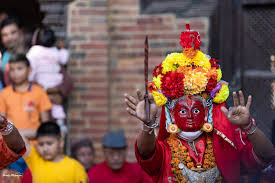
The Astamatrika Naach of Lalitpur is far more than a folk dance. It is a living cosmology a ritual enactment of the divine order as understood by the Newar people of Patan across more than three centuries. In a world that increasingly values the new over the old, this tradition reminds us that the most profound human experiences are often those rooted deepest in time.
To witness the Gaan Pyakhan is to stand at the intersection of history and the sacred, where masked figures move to ancient rhythms in a centuries-old courtyard, and where the eight mother goddesses if legend is to be believed are said to dance among us still.
The Astamatrika Naach is performed annually during the Dashain festival in Patan Durbar Square and Nakabahil Tol, Lalitpur. Visitors are welcome to observe the performances with reverence for the sacred nature of the event.